Stretch Ceiling Installation: Process, Preparation, Time and What to Expect
- Laser Accuracy (±1mm): 360-degree self-leveling laser levels ensure razor-straight perimeter profile tracks.
- Zero Dust & Dry Installation: No wet plastering, no toxic drywall sanding, and no chemical primer fumes.
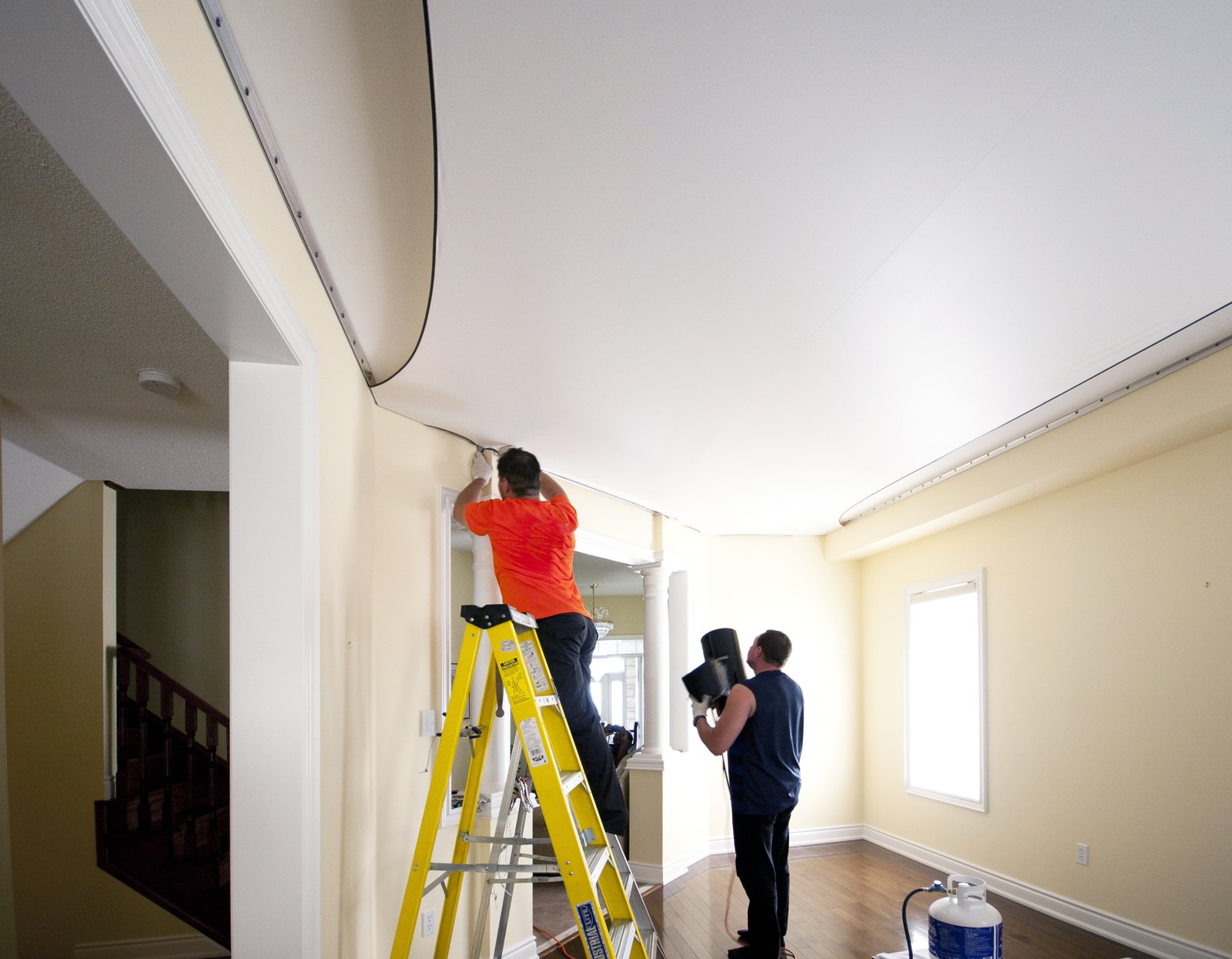
- Thermal Elastic Activation: Clean warm air (45°C–50°C) softens the membrane for precise corner and perimeter tucking.
- Swift Completion: Standard residential rooms installed and commissioned within 4 to 8 hours.
1. Phase 1: Laser Surveying & Sub-Plenum Fixture Preparation
The installation process begins with an exacting multi-point laser survey of the room perimeter, diagonals, and elevations. Before the membrane is mounted, technicians install all overhead infrastructure: electrical wiring in fire-retardant conduits, mounting platforms for recessed spotlights, and structural downrods for ceiling fans. Because the membrane cannot be altered once tensioned, every fixture location is measured and locked into CAD drawings.
2. Phase 2: Extruded Aluminum Perimeter Profile Fastening
Heavy-duty extruded aluminum profiles (h-type, ceiling-mount, or shadowline reveal profiles) are secured along the perimeter walls every 15 to 20 cm using nylon dowels and anti-vibration screws. Miters at internal and external corners are polished smooth and taped to prevent sharp burrs from contacting the membrane under tension.
3. Phase 3: Controlled Room Pre-Heating & Corner Anchoring
The packaged membrane, pre-fabricated offsite to exact dimensions (scaled 7% smaller than room dimensions to maintain permanent tension), is suspended from corner canvas clamps. A clean-air thermal cannon warms the room air to between 40°C and 50°C. Under this calibrated heat, the calendered PVC membrane becomes pliable and elastic, allowing technicians to insert the welded semi-rigid harpoon into the aluminum tracks using specialized rounded spatulas.
4. Phase 4: Perimeter Tucking, Cooling & Luminaire Reinforcement
Technicians progress from corners toward center points, seating the harpoon securely into the locking channel. As the heat source is deactivated and room temperature normalizes (24°C–28°C), the membrane contracts, locking under permanent, drum-tight tension with zero wrinkles. Transparent thermal-stabilized acrylic reinforcement rings are glued at fixture locations, internal apertures are scalpel-cut, and luminaires are connected. Book a technical survey on our Turnkey Installation Hub.
Book a Site Survey with Our Installation Engineers
Our certified teams execute complete residential and commercial stretch ceiling installations with full 10-year warranty coverage across India.